
Europe's Darkening Future
What I saw on a little trip to the world's prettiest village

What Austria Tells Us About Europe’s Dark Future
I’m in Hallstatt, Austria. Heard of it? Perhaps not, though you’ve almost certainly seen it - on a poster, as a desktop screensaver, or in the feed of one of those social media accounts with millions of followers, the ones that exalt the beautiful and old and mock the ugly and new. Often justly.
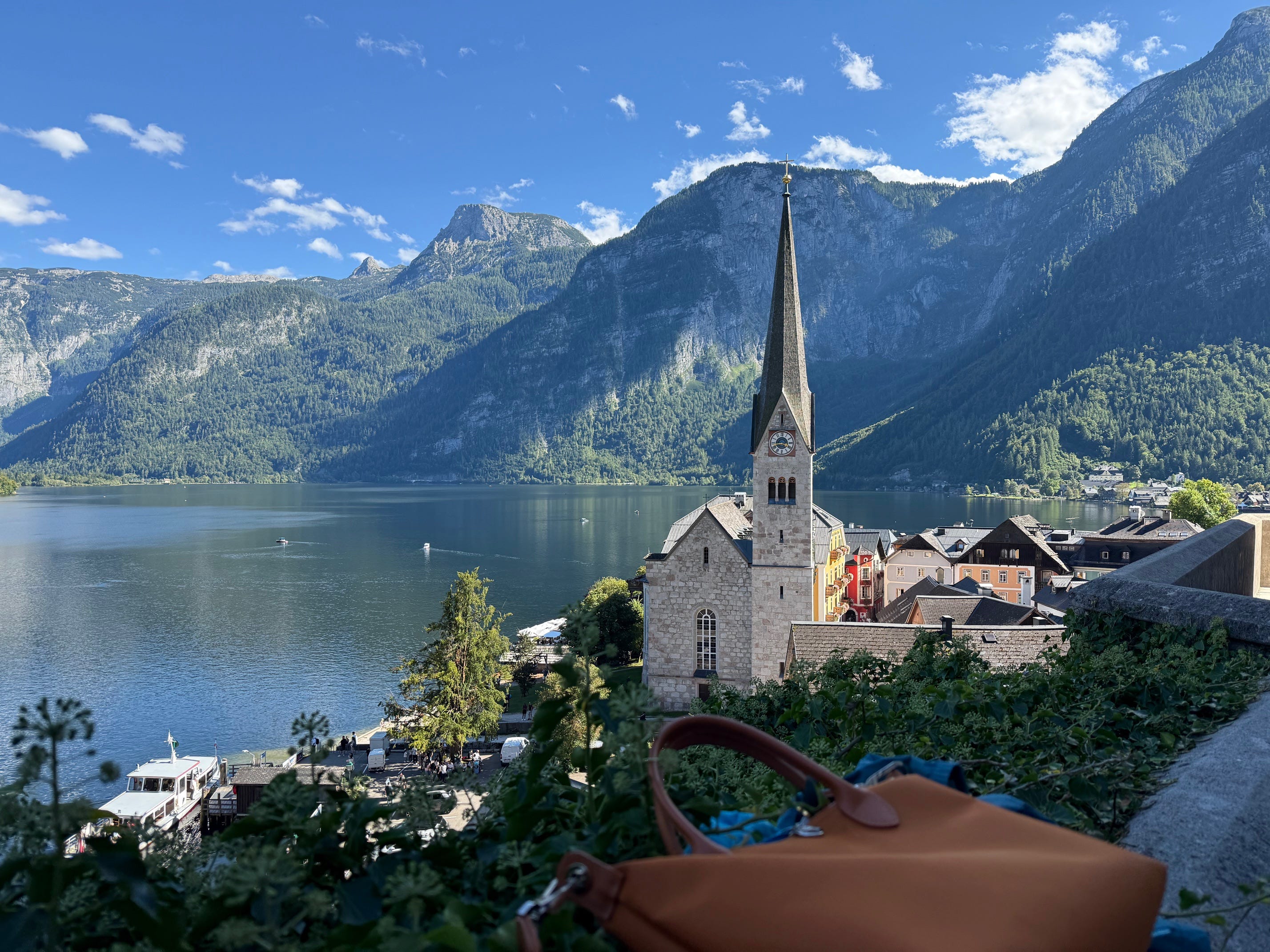
These accounts like to show Hallstatt because it is accidentally yet exquisitely lovely. A Tiktok-perfect Alpine town, stretched narrowly along the glittering shore of an iconically blue lake, complete with Hansel-and-Gretel houses and one ideal church spire, noble against the vistas of boats, mountains, and the many tourist buses. If there is a poster-child for over-tourism, it might show Hallstatt. Which would then attract more tourists.
There are, of course, lots of over-touristed towns in Europe. What makes Hallstatt special is what lies above it, the remarkable backstory that attracts historians and archaeologists, and makes a total contrast with the selfie-sticks down below. And it’s this dual, competing nature of Hallstatt that, I believe, makes Hallstatt oddly emblematic, and offers a prism through which to view Europe’s troubled future. Especially on a day like today, when news is filtering in of Trump’s latest adventures, amid Putin’s ongoing and ceaseless designs on Ukraine.
All along the mountain ridge, behind Hallstatt, the slopes are honeycombed with grandiose salt mines, and have been for 7,000 years. You can go down and see the “world’s oldest ladder,” the seams of salt worked by organised, hierarchical teams of men wielding antler picks. You can see poignant leather shoes and dainty woollen clothes - all preserved in the salt they hewed.
Hallstatt is arguably the earliest “industrial” site in the world. By the 10th century BC, when the Celts toiled here (giving their name to the entire Hallstatt Celtic culture) the salt trade was enough to make the town wealthy and remarkably well-connected. Archaeologists have found Etruscan bronzes, Baltic amber, Carpathian gold, Mediterranean coral.
In a sense, Hallstatt is the fons et origo of European-ness, of European genius. Here is the original cradle of European industriousness, invention, trade. And yet here, where we see Europe’s first industry, is also where we see its “last”: tourism.
Where once Europeans hacked at stone for salt, exporting it across a continent, now Europe’s business model is to sell itself - its views, its pastries, its past. This shift from producer to curator represents more than an economic change; it signifies a psychological one. And that, I suspect, is where the looming trouble lies.
Look at it this way, the tourist trade was meant, consciously or not, to be part of Europe’s final salary pension scheme. But as I’ve travelled Austria, I’ve gained the uneasy sense that Europe’s retirement plan is going wrong. Just as the old continent settles into old age, deckchairs unfurled, factories closing even as museums open - the wider world has become far less obliging. Yes, Europe may urgently wish to retreat into a spa town, but the 21st century has other plans. Which require a different state of mind.
For seventy years Europe has been disarming itself, not just physically, but mentally and emotionally. The EU is, after all, overtly a “peace project”, a bureaucratic construct meant to squash militaristic nationalism, and stop London, Paris, Rome, Berlin sending young men to die. It has tried to smooth pride into peaceable regulation - making patriotism seem not only dangerous but absurd.
Now the consequences of this project are upon us. Putin looks likely to invade Europe’s east; Trump is violently reviving the Monroe Doctrine; China further projects its power. And so we abruptly realise we still need young Europeans to volunteer, to fight, and perhaps even die, for their countries.
And yet, armies across the continent cannot find the soldiers. Germany’s armed forces are short of 20,000 troops. France has missed its recruitment target by 25%. The British army is down to 75,000. The Netherlands is 15% short of full military strength.
Even if governments mandate national service, they cannot mandate a martial spirit. In spring 2025, Denmark’s Prime Minister, Mette Frederiksen, made a speech to a group of university students and, with startling candour, addressed the problem, noting that this is about minds as much as bodies. As she put it: ‘We will need a form of rearmament that is just as important [as the military one]. That is the spiritual one.’ In other words, for too long we have taught ourselves we have nothing to be proud of, and now we see the result: a generation that wonders if there is anything worth fighting for.
Is there a solution? Yes, there is. And it is visible about twenty minutes away from Hallstatt, in the little town of Bad Aussee. There, young and old alike, they wear the national costume - dirndls and lederhosen - not for the tourists, but for themselves. Archaeology shows they’ve been wearing something-like-dirndl here since the Iron Age: they wore it during the peak of the salt mining, and they wear it still: for church, for the market, for a stroll. It is a quiet, unselfconscious declaration of European belonging and identity. It is not bellicose or aggressive, but it is a strong and defiant rootedness.
Therefore, Europe needs a lot less guilt and a lot more of this cultural confidence. Forget the chauvinism that starts wars, but cultivate the national pride that can win them. We need to teach our kids the stuff that makes you think: yes, this is mine, it is ours, it has been ours for centuries, and I would give my life to save it for my children. Because without it we might be lost.
Back in Hallstatt the mines are closed for the season. I am one of the last to make it to the breezy funicular, as everyone heads down for wiener schnitzel and crisp Styrian white. Winter is definitely here. The lake ripples in the wind, and grey clouds tumble over the Dachstein and the Sarstein. The view is still perfect. The question is whether the spirit that built it is still there: waiting, ready, beneath the beautiful surface.
Gee, if EU militaries are having so much difficulty recruiting, there just happens to be literally hundreds of thousands of military age Muslim migrants in every European country, though giving them military training may not be that great an idea.
They reap what they sow. Telling people (western) traditions are “bad/right-wing/etc.(take your bullshit pick of the week)” has consequences. Delegating former national laws to the Eurocrats is (another) nail in the coffin of national pride.
¯\_(ツ)_/¯